MPO vs LC: Choosing the Right Patch Panel for Your Data Center
By Jergeo Engineering Team | Published June 2026 · 7 min read
When selecting a fiber patch panel for a data center, the connector type determines density, cost, and future upgrade path. The two dominant choices are LC duplex (the established standard) and MPO (the rising standard for 40G/100G/400G/800G). Below is a technical comparison to help you spec the right panel.
Summary
MPO patch panels use multi-fiber connectors (12 or 24 fibers per connector) for high-density data center environments, while LC panels use single-fiber connectors for standard enterprise networks.
LC Duplex: the reliable workhorse
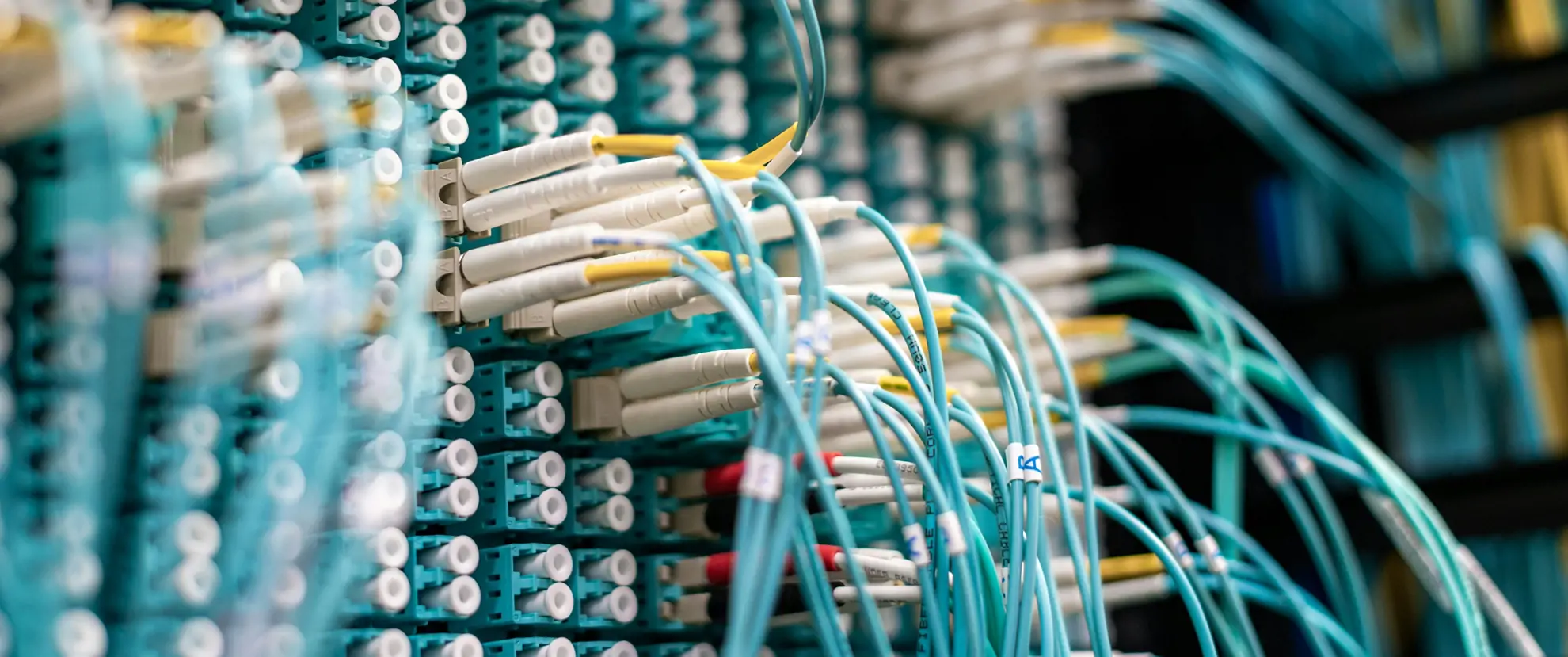
LC duplex connectors have been the data center standard for over a decade. Each LC duplex connection carries 2 fibers (one TX, one RX) in a compact 1.25mm ferrule format. Key characteristics:
- Port density: 24-48 LC duplex ports per 1U panel is standard; high-density panels reach 72-144
- Insertion loss: 0.15 dB typical — among the lowest of any connector
- Speed support: 1G/10G/25G per fiber pair; sufficient for most server and management connections
- Cost: LC patch cords and adapters are commodity-priced, widely available
- Skill requirement: Standard fiber training is sufficient; single-fiber cleaning and inspection
MPO: built for parallel optics
MPO (Multi-fiber Push-On) connectors carry 12, 16, 24, or 32 fibers in a single ferrule. They are the standard for parallel optics transceivers (40G/100G/400G/800G) because one MPO connector replaces 6-16 LC duplex pairs. Key characteristics:
- Port density: 12-24 fiber cores per connector position; a 1U MPO panel can terminate 144+ fibers
- Insertion loss: 0.25-0.35 dB typical — slightly higher than LC due to multi-ferrule alignment
- Speed support: 40G (MPO-12), 100G/400G (MPO-12 or MPO-24), 800G (MPO-16/MPO-24)
- Cost: MPO cassettes and trunk cables cost 2-3x more than LC equivalents per fiber
- Skill requirement: MPO end-face inspection requires specialized equipment; polarity management adds complexity
Side-by-side comparison
| Parameter | LC Duplex | MPO |
|---|---|---|
| Fibers per connector | 2 | 12/16/24 |
| Max speed per connector | 25G | 400G/800G |
| Ports per 1U panel | 24-144 | 72-144 (fiber count) |
| Insertion loss | 0.15 dB | 0.25-0.35 dB |
| Relative cost per fiber | 1x | 2-3x |
| Polarity management | Simple (A-B) | Complex (Method A/B/C) |
| Best for | Server access, mgmt network | GPU interconnect, spine links |
When to choose LC
- Server access layer (1G/10G/25G NIC connections)
- Management and out-of-band networks
- Storage area networks (FC/FCoE)
- Any link running at 25G or below per fiber pair
- Teams without MPO inspection tools or polarity training
When to choose MPO
- GPU cluster interconnects (InfiniBand HDR/NDR, 400G/800G Ethernet)
- Spine-leaf backbone links running 100G/400G
- Any deployment using parallel optics transceivers
- Greenfield data centers designing for AI workloads from day one
The hybrid approach: best of both
Most AI data centers use a hybrid approach: MPO for GPU-to-spine interconnects and LC for server access and management. Jergeo patch panels support this directly — the modular adapter strips accept both LC and MPO adapters in the same 1U chassis. You can run MPO trunks into the top half of the panel for GPU connections and LC jumpers in the bottom half for management, without needing two separate panels.
Related Products
References
Key takeaway
Use LC for access-layer and management connections. Use MPO for GPU interconnects and backbone links. Specify hybrid panels that support both connector types in the same chassis — this reduces rack space consumption and simplifies cable management.
Related products
Related Articles
Fiber Optic Patch Panel Guide
Complete guide to selecting the right patch panel configuration for your data center.
Read Article →
ODF vs Fiber Patch Panel: What's the Difference?
When to use an ODF frame versus a standard patch panel for indoor fiber management.
Read Article →
AI Data Center Fiber Management
How MPO vs LC choices affect fiber density in AI GPU cluster environments.
Read Article →