From apartment blocks to mountain villages — last-mile fiber, done right
Three FTTH scenarios, three deployment architectures, one product line. Whether it is a 10,000-unit residential complex, a 50-story commercial tower, or a 200-household village 20km from the nearest CO — the right architecture and product selection make the difference between a network that works and one that does not.
Residential Community FTTH
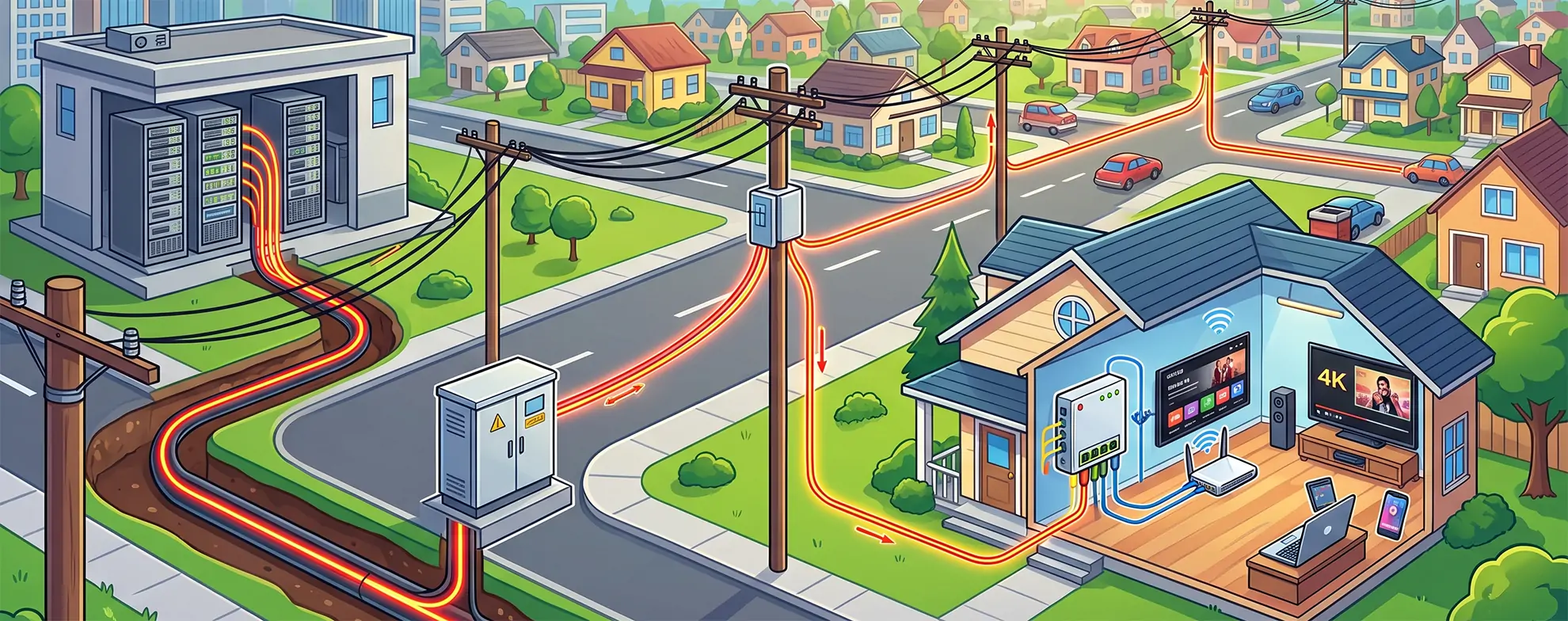
The most common FTTH scenario: 2,000–10,000 households across 20–50 buildings. Four-tier architecture from community cabinet to in-home terminal, with standardized products at every layer.
Four-tier architecture
What this solves
High-Rise Vertical Fiber Cabling
A 50-story tower is not just a tall apartment building. The riser shaft carries hundreds of fibers in a space shared with power, fire, and security systems. Vertical cabling needs multi-stage splitting, fire-rated components, and a backbone you will never need to replace.
Vertical split architecture
Optical power budget (50-story example)
Fire-Rated Materials
Enclosure materials meet UL94 V-0 flammability rating, suitable for indoor vertical riser installations per building code requirements.
Pre-terminated Backbone
Factory-spliced riser cables arrive on reels. Pull, plug, test. Riser installation in hours, not days.
Splitter Strategy
1:32/64 at MDF, 1:8/16 at IDA, 1:4 at floor. Balanced power budget at every tier.
Rural & Remote Area FTTH Coverage
50–300 households spread across 5–20 km². No reliable power, no sheltered equipment rooms, and every truck roll costs a day. This solution prioritizes solar power, IP67+ protection, and zero-maintenance design over everything else.
Cabinet material selection for rural conditions
| Material | Weight | Corrosion | Cost | Best For |
|---|---|---|---|---|
| SMC | Light (~1.9g/cm³) | Excellent (1000h salt spray) | Medium | Coastal / humid / acid rain |
| Galvanized Steel | Medium | Good (periodic maintenance) | Lower | Inland, general environment |
| 304 Stainless Steel | Heavy (~7.9g/cm³) | Outstanding | Higher | Industrial / extreme corrosion |
Rural-specific design considerations
Tell us your FTTH scenario
Building type, subscriber count, distance from CO, environment conditions — share your project details and we will recommend the right architecture and product mix within 1 hour.