ODF vs Patch Panel: What's the Difference?
By Jergeo Engineering Team | Published June 2026 · 6 min read
Network planners often confuse optical distribution frames (ODF) with fiber patch panels. Both manage fiber optic cables, but they serve different network layers and handle vastly different port densities. Here are the technical differences.
Summary
An ODF is a full-height floor-standing frame for central office fiber management, while a fiber patch panel is a smaller wall-mount or rack-mount unit for server rooms. Both use the same adapter and splice module technology.
What is an optical distribution frame (ODF)
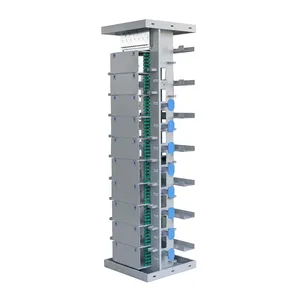
An optical distribution frame is a floor-standing or wall-mounted rack structure for high-capacity fiber termination and cross-connection in central offices, data centers, and telecom hubs. ODFs use modular splice and distribution modules to terminate hundreds or thousands of fiber cores. Key characteristics:
- Capacity: 432 to 1,440+ ports per frame
- Rack structure: 42U or taller, standalone floor-standing design
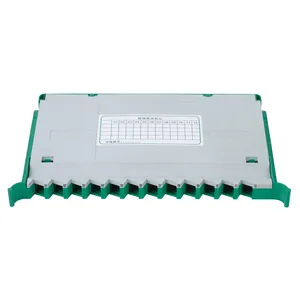
- Modularity: Accepts 60+ splice/distribution modules; modules are field-swappable
- Cable entry: Top and bottom entry with dedicated routing channels
- Application: Central office cross-connect, data center meet-me rooms, high-density fiber aggregation
What is a fiber patch panel
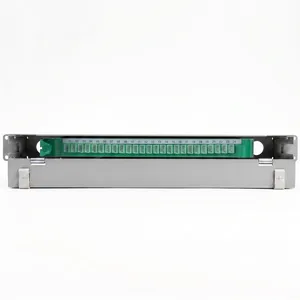
A fiber patch panel is a rack-mounted enclosure (typically 1U-4U) for lower-density fiber termination in equipment rooms and data center racks. Patch panels mount inside standard 19-inch racks and terminate fibers with adapters (LC, SC, FC) for patch cord connections. Key characteristics:
- Capacity: 12 to 144 ports per panel
- Rack structure: 1U-4U, mounts inside standard 19-inch server/telecom racks
- Modularity: Fixed or removable adapter strips; some models accept slide-out trays
- Cable entry: Rear entry with simple cable management
- Application: Equipment room termination, patch field connections, lower-density fiber distribution
Key differences: capacity, modularity, and rack compatibility
The distinction between ODF and patch panel comes down to three factors: port density, structural design, and deployment scenario.
Capacity and port density
ODFs handle 400-1,400+ ports in a single frame. The Jergeo JODF-C2, for example, terminates 1,440 ports in a 2200×850×600mm frame using 60 splice/distribution modules. Patch panels top out at 144 ports per 1U-4U enclosure. The Jergeo JODF-U1 handles 12-144 ports depending on configuration. When you need to terminate 864 fibers from incoming outside plant cables, you need an ODF. When you need 48 ports to patch equipment in a rack, you need a patch panel.
Rack compatibility and physical design
ODFs are standalone floor-standing frames (sometimes wall-mounted). They include their own 19-inch rack mounting structure but are not designed to fit inside a server rack. The Jergeo JODF-A1 occupies 2000×550×550mm of floor space and provides 42U of internal mounting capacity. Patch panels slide into standard 19-inch equipment racks. The Jergeo JODF-U3A slides into any standard rack and occupies 1U (43mm height) for 24 ports or 3U for 96 ports.
Modularity and scalability
ODFs use a modular architecture: you install splice/distribution modules into the frame, and you can add or swap modules without disrupting other connections. The JODF-B1 ships with 60 modules pre-installed, but you can reconfigure module types (splice vs. distribution) in the field. Patch panels use fixed adapter strips or slide-out trays. The Jergeo JODF-U2 uses a rotary design that lets you swing the front panel open for rear access. The JODF-U3A uses a slide-out tray for maintenance. Both are modular, but at a much smaller scale than ODF modules.
Side-by-side comparison
| Parameter | ODF (Optical Distribution Frame) | Fiber Patch Panel |
|---|---|---|
| Capacity range | 432–1,440+ ports | 12–144 ports |
| Rack type | Floor-standing (42U+) | 19-inch rack mount (1U-4U) |
| Port density per unit | High (60+ modules per frame) | Low (12-144 per panel) |
| Physical dimensions | 2000×550×550mm to 2200×850×600mm | 43×482×250mm (1U) typical |
| Modularity | 60+ field-swappable modules | Fixed or slide-out adapter trays |
| Cable entry | Top and bottom with dedicated channels | Rear entry with simple management |
| Typical use case | Central office cross-connect, meet-me room | Equipment room patch field |
| Scalability | High (add modules, expand to 1,440+ ports) | Limited (add more panels to rack) |
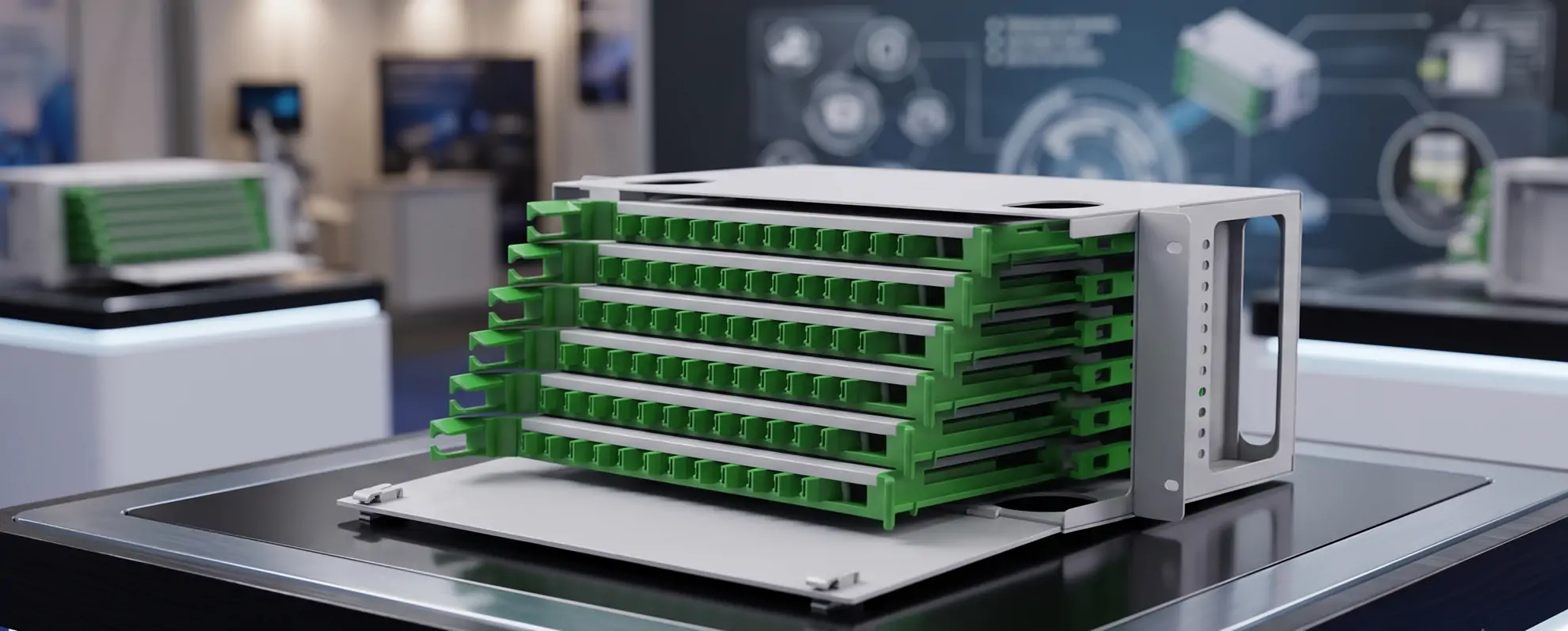
When to use an ODF
- Central office environments where you need to cross-connect 500+ incoming outside plant cables to distribution cables
- Data center meet-me rooms where service providers terminate their fiber plants
- High-density fiber aggregation points (campus backbone, building entrance)
- Deployments requiring modular expansion: start with 432 ports (JODF-C1) and scale to 1,440 ports (JODF-C2) by adding modules
- When you need dedicated top/bottom cable entry with independent wiring channels for maintenance
When to use a fiber patch panel
- Equipment rooms where you need to terminate and patch 24-96 fibers per rack
- Data center top-of-rack or end-of-row distribution for server/storage connections
- Lower-density fiber runs where individual adapter access is sufficient
- When rack space is constrained and you need a compact 1U-3U solution
- When you need slide-out or rotary designs for easy front/rear access during maintenance
Hybrid solutions: modular ODF with patch panel modules
The boundary between ODF and patch panel blurs when you use modular ODF frames loaded with distribution modules. The Jergeo JODF-A1 uses 42U of internal rack space to accept both splice modules (for fiber termination) and distribution modules (with adapter panels that function like rack-mount patch panels). This hybrid approach lets you:
- Terminate 720 incoming fibers with splice modules in the upper half of the frame
- Install distribution modules with LC/SC adapters in the lower half for patch cord connections
- Maintain all connections in a single frame instead of splitting between an ODF and separate patch panels
This is the approach most central offices and large data centers use. The ODF frame provides the structure and cable management; the modules provide the termination and patching flexibility.
Related Products
References
- FOA ODF Reference — The Fiber Optic Association technical reference on optical distribution frames
- Lightwave — optical communications industry news and technical resources
Key takeaway
Choose an ODF when you need high-capacity fiber termination (400-1,400+ ports) in a central office or meet-me room. Choose a fiber patch panel when you need lower-density termination (12-144 ports) inside a standard equipment rack. For deployments that need both, use a modular ODF frame loaded with distribution modules to consolidate termination and patching in a single enclosure.
Related products
Related Articles

Fiber Optic Patch Panel Guide
Complete guide to selecting the right patch panel for indoor fiber distribution.
Read Article →
MPO vs LC Patch Panel
Choosing between MPO and LC adapter configurations for high-density applications.
Read Article →
Fiber Distribution Cabinet Buying Guide
How to choose between indoor ODF and outdoor FDC for different deployment scenarios.
Read Article →