Outdoor Fiber Termination Box Selection Guide: Capacity, IP Rating, and Installation
By Jergeo Engineering Team | Published June 2026 · 9 min read

A fiber termination box outdoor is where the feeder cable meets the drop cable. It sits at the network edge — on a building wall, a utility pole, or inside a pedestal — and its job is to protect fiber splices and adapters from weather while giving technicians a structured point to patch subscribers in. Get the wrong box and you end up with water ingress, overloaded splice trays, or a technician who cannot fit a hand inside to work on connectors.
Summary
An outdoor fiber termination box connects the last drop cable to the subscriber's premises, available in wall-mount and pole-mount versions with 2 to 24 ports and IP65 or IP67 ratings.
Below are the selection criteria we use when specifying an outdoor fiber optic termination box for FTTH, FTTB, and campus deployments. The examples reference our JOTB series (JOTB-2A through JOTB-192A) because they cover the full range from 2-port residential drops to 192-port aggregation points, but the logic applies to any brand.
Where outdoor fiber termination boxes are used
These boxes appear at three points in a passive optical network:
- FTTH last mile: The box terminates the feeder cable from the splitter cabinet and provides adapter ports for individual subscriber drop cables. A typical installation serves 2 to 24 homes from a single enclosure mounted on the building facade.
- FTTB / FTTdp: Fiber to the building or distribution point uses higher-capacity boxes (48–192 ports) mounted in stairwells, basements, or on exterior walls. They distribute to multiple MDUs or office units within the building.
- Campus and enterprise: Campus backbones that need a weatherproof splice and distribution point between buildings use mid-range boxes (12–48 ports). These are functionally identical to FTTH boxes but often carry single-mode splices for longer reaches.
The enclosure must handle the same environmental conditions regardless of the use case: rain, UV exposure, temperature swings, and physical impact. The difference is scale.
Capacity selection: 2 ports to 192 ports
Port capacity is the first decision. It determines the physical size of the box, the number of splice trays, and how many subscriber drops you can serve. Undersizing means adding a second box later; oversizing wastes money and wall space.
Here is how we map capacity to typical use cases:
| Capacity | Typical Use Case | Example Model | Dimensions | Shell |
|---|---|---|---|---|
| 2 ports | Single home FTTH drop; pole mount | JOTB-2A | 86×86×25 mm | ABS |
| 4 ports | Small cluster; 2–4 subscribers | JOTB-4A | 170×98×36 mm | Metal |
| 8 ports | Small building; wall mount | JOTB-8A | 280×130×40 mm | Metal |
| 12 ports | Standard 12 core fiber optic terminal box for MDU | JOTB-12A / 12B | 260×160×38 / 355×144×53 mm | Plastic / Metal |
| 24 ports | Medium building or FTTB aggregation | JOTB-24A | 260×127×38 mm | Plastic |
| 48 ports | Large apartment block or campus node | JOTB-48B | 380×325.5×92 mm | Cold rolled steel |
| 192 ports | High-density aggregation; multi-building | JOTB-192A | 600×605×300.5 mm | Cold rolled steel |
A rule we follow: never fill a box to 100% capacity in the design phase. Leave 15–20% headroom for spares and future subscribers. If you need 10 active ports, spec a 12-port box, not an 8-port.
IP rating and weatherproofing
Outdoor enclosures need to keep water and dust out. The IP (Ingress Protection) rating tells you the level of sealing. Two ratings appear across the product range:
- IP54: Protected against limited dust ingress and water splashes from any direction. Suitable for sheltered outdoor positions — under eaves, covered walkways, or semi-enclosed areas. The JOTB-4A, JOTB-8A, JOTB-12A, JOTB-12B, and JOTB-24A all carry IP54.
- IP65: Dust-tight and protected against water jets from any direction. Required for fully exposed installations — on poles, on building facades with no overhang, or in areas with heavy wind-driven rain. The JOTB-2A, JOTB-48B, and JOTB-192A are rated IP65.
For installations where air pressure varies significantly (altitude above or below standard), verify that the enclosure rating covers your site. The air pressure specification ranges from 80–106 kPa for IP65 models and 70–106 kPa for IP54 models. If a box will face direct tropical sun or arctic cold, pay attention to the working temperature range. IP65 steel and ABS boxes (JOTB-48B, JOTB-192A, JOTB-2A) operate from −45°C to +65°C, while IP54 models (JOTB-4A through JOTB-24A) are rated −25°C to +40°C. The difference matters in northern climates or desert deployments.
All models share a similar humidity tolerance: ≤95% at 40°C for IP65 models, and ≤85% at 30°C for IP54 models. If your site has higher humidity — a coastal installation or a tropical climate — go with IP65.
Connector types and adapter configuration
The adapter type determines what patch cords your field technicians carry. Three connector families are standard in outdoor termination boxes:
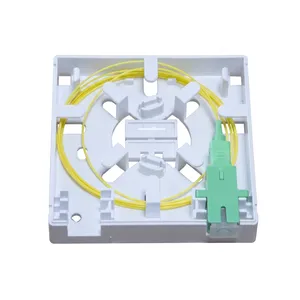
- SC: Push-pull 2.5mm ferrule. Most common in FTTH networks worldwide. Simple to mate, reliable in outdoor environments. The JOTB-2A ships with SC adapters as standard.
- LC: Push-pull 1.25mm ferrule. Higher port density per unit area. Increasingly common in FTTB and data center interconnect applications where space is constrained.
- FC: Screw-on 2.5mm ferrule. Preferred in environments with high vibration (near railway lines, industrial equipment) because the threaded coupling prevents accidental unmating.
Across the JOTB range (except the JOTB-2A which is SC-only), all models support FC, SC, and LC adapters. The adapter type is configurable at order time — you specify which connector type you need, and the box ships with the matching adapter strips pre-installed. Pigtails are also optional: if you are splicing directly to the feeder cable, you do not need pre-terminated pigtails.
For the JOTB-48B and JOTB-192A, the adapter configuration is where planning matters most. The JOTB-192A supports up to 192 splice sleeves and up to 8 splice trays. That gives you room for 192 individual fusion splices plus adapter patching on the front panel. The JOTB-48B supports 72 splice sleeves with up to 2 splice trays — sufficient for a 48-port box where some ports use direct splice and others use pigtail-to-adapter patching.
Wall-mount vs pole-mount installation
Mounting method determines which boxes you can use and what hardware you need on site.
Wall mounting
Every model in the JOTB series supports wall mounting. The smaller models (JOTB-4A, JOTB-8A, JOTB-12A, JOTB-12B, JOTB-24A) mount with simple brackets or expansion bolts. The JOTB-48B and JOTB-192A include 4 expansion bolts each — the 192A requires all four because of its 600×605×300.5 mm size and steel shell weight.
Wall mounting is the default for building facades, stairwells, and indoor-outdoor transition points. It gives the best ergonomics for technicians working on splices and patching.
Pole mounting
Only the JOTB-2A explicitly supports pole mounting out of the box (it lists "Wall mounting, Pole mounting" in its mounting type). At 86×86×25 mm and ABS construction, it is the only model light enough and small enough to strap directly to a utility pole without a bracket adapter. Its IP65 rating and −45°C to +65°C operating range make it suitable for pole-top installations in any climate.
For larger boxes on poles, you need a separate pole-mount bracket kit (stainless steel band or adjustable arm). This is not included with the standard package but is a common field accessory. If pole mounting is your primary installation method, spec the JOTB-2A for individual subscriber endpoints, or plan bracket hardware separately for larger enclosures.
How cables enter the box determines where you route them — from underground conduit, overhead on a pole, or along a building wall. Three entry methods are standard:
- Bottom entry: Cables come from below through sealed glands. Standard for underground installations where the feeder cable exits a duct at ground level and enters the box base.
- Top entry: Cables drop from above. Used for overhead pole-mount installations where the cable comes down from an aerial span.
- Side entry: Cables enter from the left or right. Used when cables run along a wall or through a horizontal conduit.
The JOTB-48B specifies 4 inlet ports and 4 outlet ports, giving flexibility for multi-cable routing. The JOTB-2A has 1 inlet port and 1 outlet port — sufficient for a simple point-to-point drop. Both models use worm-gear pipe clamps (φ9–16 mm) for cable sealing, which accommodates a range of cable outer diameters without needing custom grommets.
The larger models (JOTB-192A) use 8 worm-gear pipe clamps and include 15 plastic cable ties (100×3 mm) for internal cable management. The 8 meters of fiber protection tube included with the JOTB-192A provides additional routing protection for fibers between the splice trays and the adapter panel.
Shell material: plastic vs metal vs steel
Three shell materials appear across the range, and each has trade-offs:
- ABS plastic (JOTB-2A): Lightest weight, lowest cost, UV-stabilized for outdoor use. IP65 rated. Best for pole-mount and lightweight wall-mount applications. The trade-off is lower impact resistance compared to metal.
- Metal / Plastic (JOTB-4A through JOTB-24A): Metal shells (JOTB-4A, JOTB-8A, JOTB-12B) offer better impact resistance and EMI shielding. Plastic shells (JOTB-12A, JOTB-24A) are lighter and cheaper. Both are IP54 rated.
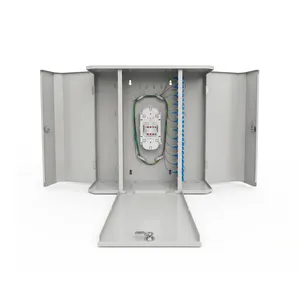
- Cold rolled steel (JOTB-48B, JOTB-192A): Heaviest, most robust, IP65 rated. These are the boxes for high-value aggregation points where vandalism risk, physical impact, or extreme weather are concerns. The JOTB-192A uses 3 front doors for sectional access — you can open only the door covering the tray you need to work on, leaving the rest sealed.
All models operate in both outdoor and indoor environments. If a box will sit inside a conditioned equipment room, the IP54 plastic or metal models are more than adequate and cost less.
Putting it together: a selection checklist
When specifying a fiber termination box outdoor for a project, work through these questions in order:
- How many subscriber ports do you need? Count active drops, add 15–20% spare, and select the next capacity tier up.
- Is the box fully exposed to weather? If yes, you need IP65 (JOTB-2A, JOTB-48B, JOTB-192A). If sheltered, IP54 is sufficient.
- What is the extreme temperature at the site? Below −25°C or above +40°C requires an IP65 steel or ABS model rated to −45°C / +65°C.
- Which connector type does the network use? SC is standard for FTTH; LC for high-density FTTB; FC for vibration-prone sites.
- Wall mount or pole mount? Pole mount narrows you to the JOTB-2A or requires a separate bracket kit.
- Which cable entry direction? Match inlet/outlet port count and position to your cable route plan.
Related Products
References
Key takeaway
Match capacity to subscriber count with 15–20% headroom. Choose IP65 for fully exposed installations and IP54 for sheltered positions. Confirm the working temperature range covers your site extremes. Standardize on one connector type across the project to simplify field splicing and spare parts. And always verify cable entry direction before ordering — retrofitting cable glands on site is a common avoidable delay.
Related products
Related Articles
Fiber Cabinet Materials: SMC vs Steel vs ABS
Material comparison for outdoor enclosures — same principles apply to termination boxes.
Read Article →
Fiber Splice Closure Guide
When to use a termination box vs a splice closure in outdoor fiber networks.
Read Article →
ODN Equipment Complete Guide
Complete list of all passive fiber network components and their roles in the ODN.
Read Article →