Fiber Cabinet Materials: SMC vs Steel vs ABS Compared
By Jergeo Engineering Team | Published June 2026 · 9 min read
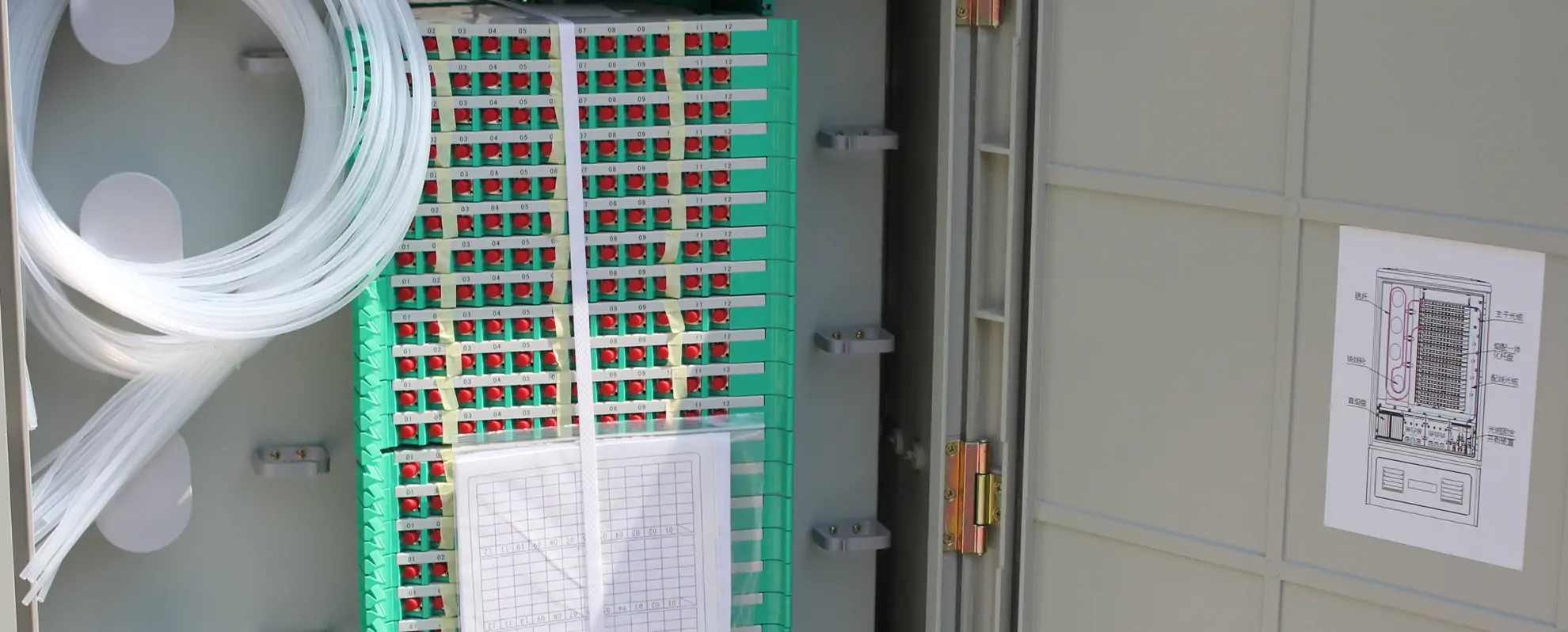
The enclosure material determines how long a fiber optic cabinet survives in the field. UV radiation, salt spray, thermal cycling, and physical impact all attack the shell year after year. Choosing the wrong material means premature replacement — and a truck roll to swap a corroded box costs far more than the box itself. The three materials you will encounter in fiber distribution cabinets are SMC (Sheet Molding Compound), cold-rolled steel, and ABS plastic. Each occupies a different point on the cost-versus-durability curve.
Summary
SMC is the best choice for outdoor FDCs due to UV resistance, zero corrosion, and 20+ year lifespan. Stainless steel suits coastal/industrial sites. ABS and PC+ABS are standard for indoor distribution boxes.
SMC (Sheet Molding Compound)
What it is
SMC is a fiber-reinforced thermoset composite. The base formulation combines unsaturated polyester resin with chopped glass fibers (typically 25–35% by weight), mineral fillers such as calcium carbonate, and additives for curing, UV stabilization, and flame retardancy. The mixture is formed into a sheet, then compression-molded under heat (140–160 °C) and high pressure into the final cabinet shell. The result is a single-piece or two-piece enclosure with no weld seams.
Advantages
- Corrosion resistance: SMC does not rust, pit, or oxidize. It performs identically in coastal salt-spray environments and industrial chemical zones where steel cabinets fail within 3–5 years even with powder coating.
- Weight: SMC density is roughly 1.7–2.0 g/cm³ compared to 7.85 g/cm³ for steel. A typical 288-port SMC cabinet weighs 15–25 kg; an equivalent steel unit weighs 40–60 kg. This matters when mounting on poles or walls with limited load capacity.
- Electrical insulation: SMC is non-conductive (dielectric strength ~15 kV/mm). There is no grounding requirement for the shell itself, which simplifies installation and eliminates galvanic corrosion between the enclosure and mounting hardware.
- Thermal stability: SMC cabinets from Jergeo's FDC series are rated −45 °C to +80 °C. The material does not become brittle at low temperatures or soften at high temperatures — it maintains structural integrity across the full operating range.
- UV resistance: UV inhibitors are compounded into the material (not just surface-coated), so protection does not degrade over time. Color stability and mechanical strength are maintained for the product's service life.
- Impact resistance: Charpy impact strength of 60–100 kJ/m² for SMC, depending on glass fiber loading. The material absorbs impact energy through micro-cracking of the matrix without catastrophic failure.
- Moldability: Complex shapes, integrated cable entry glands, ventilation channels, and mounting flanges can be molded in a single operation — reducing assembly steps and potential leak points.
Disadvantages
- Cost: Tooling (compression molds) costs more upfront than sheet metal stamping dies. SMC is economically justified at moderate-to-high volumes. For one-off custom sizes, tooling cost can be a barrier.
- Rigidity limits: SMC is stiff but not as structurally rigid as steel at the same wall thickness. Large cabinets (576+ ports) may require internal metal reinforcement frames — Jergeo's FDC series uses a metal internal structure with SMC shell to combine both benefits.
- Repairability: A cracked SMC panel cannot be welded back. Field damage usually requires full panel replacement, whereas a dented steel panel can sometimes be hammered flat.
- Surface finish: The matte, slightly textured surface of compression-molded SMC does not achieve the mirror-smooth appearance of powder-coated steel. This is cosmetic only — the surface resists dirt pickup well.
Cold-Rolled Steel
What it is
Cold-rolled steel (CRS) sheet, typically 1.0–2.0 mm thick, is cut, bent, and welded into the cabinet body. After fabrication, the shell undergoes surface treatment: phosphating, then electrostatic powder coating (epoxy-polyester hybrid or pure polyester), and finally heat curing at 180–200 °C. The coating thickness is typically 60–80 μm.
Advantages
- Mechanical strength: Steel has higher tensile strength (≥300 MPa for CRS) than SMC (≈100 MPa bending strength). The shell resists forced entry, vandalism, and heavy mechanical loads. For high-crime areas or roadside installations, steel provides a tangible security advantage.
- Rigidity: Steel cabinets hold their shape under load. 19-inch rack-mounting equipment can be bolted directly to steel walls without reinforcement. Jergeo's outdoor telecom cabinet series (JOC-A, JOC-B) uses cold-rolled steel specifically for this reason.
- Surface finish: Powder-coated steel achieves a smooth, uniform appearance. Colors are precise (any RAL code), and the surface is easy to keep clean in urban environments.
- Modifiability: Steel cabinets can be field-modified — additional cable entries, mounting brackets, or ventilation holes can be cut and re-painted on site.
Disadvantages
- Weight: A steel outdoor cabinet (IP55) with 1.2 mm walls and a full equipment load can weigh 60–120 kg. Pole mounting often requires additional reinforcement or is simply not feasible.
- Corrosion: Once the powder coat is scratched, chipped, or UV-degraded (typically after 5–8 years in tropical or coastal climates), rust starts. The progression is accelerating — rust undermines adjacent coating, creating larger exposed areas. In C4–C5 corrosivity environments (coastal, industrial), steel cabinets may need replacement within 8–12 years even with quality coating.
- Thermal conductivity: Steel conducts heat ~50 W/(m·K) compared to ~1 W/(m·K) for SMC. In direct sunlight, steel cabinets absorb more heat and require more active cooling (fans, heat exchangers) to maintain internal component temperatures. This raises power consumption over the cabinet's lifetime.
- Grounding: Steel shells must be grounded to prevent electrical hazards from lightning-induced currents or power line faults. This adds installation complexity and an ongoing maintenance item (grounding connection integrity).
- IP rating ceiling: Welded seams and panel joints in steel construction make it harder to achieve IP65 without additional gaskets. Jergeo's steel outdoor cabinets are rated IP55 (splash-proof), while SMC cabinets reach IP65 (water-jet proof) through molded-in seals.
ABS and PC+ABS
What it is
ABS (Acrylonitrile Butadiene Styrene) is an injection-molded thermoplastic. In telecom enclosures, you will also find PC+ABS blends — polycarbonate blended with ABS for higher impact strength and heat resistance. These are used in smaller fiber distribution boxes (12–96 ports) rather than large cabinets.
Advantages
- Low cost: ABS is the cheapest enclosure material by a significant margin. Injection molding has high tooling cost but very low per-unit cost at volume. For FTTH deployments requiring thousands of small distribution boxes, ABS reduces per-point expenditure.
- Lightweight: ABS density is ~1.05 g/cm³, making it the lightest option. A 12-port ABS fiber box weighs 0.5–1.0 kg — easily handheld during installation.
- Dimensional accuracy: Injection molding achieves tight tolerances (±0.1 mm). Snap-fit closures, integrated hinges, and cable glands can be molded with precision, reducing assembly time.
- PC+ABS upgrade: Blending polycarbonate raises impact strength (notched Izod ~400–600 J/m for PC+ABS vs ~200 J/m for standard ABS) and heat deflection temperature (HDT 100–120 °C vs ~80 °C for ABS). Jergeo's smaller distribution boxes (JFDB-12A, JFDB-16B, JFDB-24A, JFDB-32B) use PC+ABS for this reason.
Disadvantages
- UV degradation: Standard ABS degrades rapidly under UV exposure — chalking, discoloration, and embrittlement within 1–3 years of outdoor use. UV-stabilized grades extend this to 5–8 years, but the degradation is permanent and progressive. PC+ABS performs better but still falls short of SMC for long-term outdoor exposure.
- Temperature ceiling: ABS softens at ~85 °C (HDT at 0.46 MPa). PC+ABS pushes this to ~110 °C. In desert or rooftop installations where internal temperatures can exceed 65 °C, ABS boxes approach their thermal limit.
- Size limitation: Injection-molded ABS boxes are practical up to roughly 96 ports (single enclosure). Beyond that, the tool size and clamp force required become uneconomical. Large cabinets (144–1152 ports) are not made from ABS.
- Chemical resistance: ABS has poor resistance to aromatic hydrocarbons, esters, and ketones. In industrial environments with solvent vapors, the surface can craze and crack.
- Flammability: Standard ABS burns with a strong, smoky flame. Telecom grades must meet UL 94 V-0, which requires flame-retardant additives that can impact other properties.
Complete material comparison
| Parameter | SMC | Cold-Rolled Steel | ABS / PC+ABS |
|---|---|---|---|
| Weight (288-port cabinet) | 15–25 kg | 40–60 kg | N/A (too large) |
| IP rating (typical) | IP65 | IP55 | IP65 (small boxes) |
| UV resistance | Excellent (bulk UV inhibitors) | Good initially (coating); degrades 5–8 yr | Fair (stabilized grades); 5–8 yr outdoor |
| Impact strength (Charpy, kJ/m²) | 60–100 | >200 (ductile deformation) | PC+ABS: ~30–50; ABS: ~15–25 |
| Temperature range | −45 °C to +80 °C | −40 °C to +55 °C (internal limited by heat gain) | −45 °C to +65 °C (ABS); PC+ABS extends upper to ~+70 °C |
| Corrosion resistance | Immune (non-metallic) | Good with intact coating; vulnerable at scratches | Good against water; poor vs solvents |
| Thermal conductivity (W/m·K) | ~1 (insulator) | ~50 (conductor — requires ventilation) | ~0.2 (insulator) |
| Tooling cost | High (compression mold) | Medium (bending dies + welding jigs) | High (injection mold); low per-unit |
| Per-unit cost (at volume) | Medium | Medium–High (material + labor) | Lowest |
| Expected outdoor lifespan | 20–25 years | 10–15 years (coastal); 15–20 years (inland) | 8–12 years (UV-stabilized) |
| Electrical conductivity | Insulator (no grounding needed) | Conductor (must be grounded) | Insulator |
Deployment scenario recommendations
FTTH aerial and pole-mount distribution (144–576 ports)
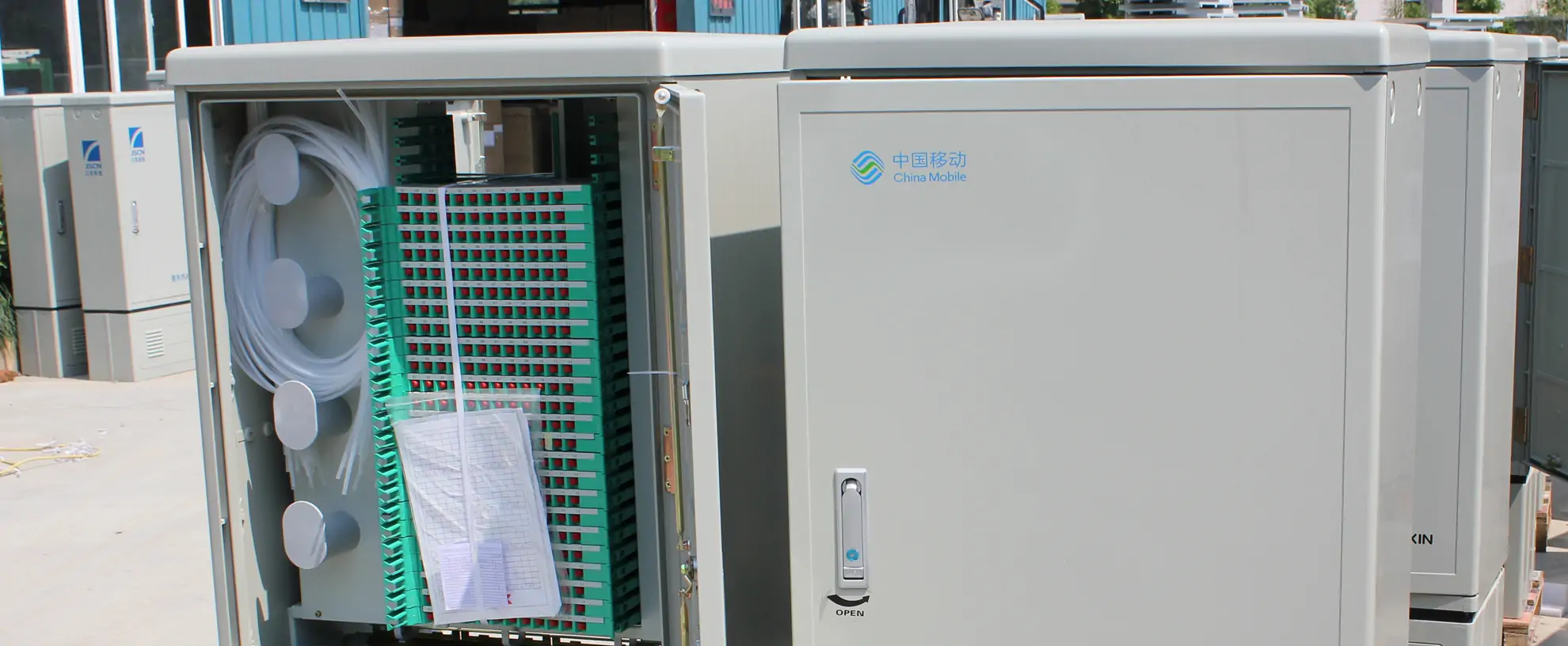
Choose SMC. Weight is the deciding factor here. A pole-mounted cabinet must be light enough for two technicians to install without mechanical lifting equipment. SMC's 15–25 kg shell weight makes this practical. The corrosion immunity matters too — these cabinets are at the network edge, often in residential areas with decades of expected service. The JFDC-288A and JFDC-576A use SMC shells with internal metal reinforcement frames, giving the best of both materials.
Underground or pit-mounted distribution
Choose SMC. Underground pits have high humidity, standing water, and hydrogen sulfide from sewage — an environment that corrodes steel rapidly. SMC is immune to all of these. IP65 rating ensures water-jet resistance during maintenance.
Rooftop or tower-base installations (active equipment)
Choose cold-rolled steel when 19-inch rack mounting is required. Jergeo's outdoor telecom cabinets (JOC-A, JOC-B) use steel construction for rigidity and equipment compatibility. The steel shell provides physical security for expensive active electronics. In these installations, the cabinets have active cooling (fans, heat exchangers) that manage the thermal conductivity disadvantage.
Coastal or marine environments
Choose SMC without exception. Salt spray (classified as C4–C5 corrosivity) destroys steel powder coatings at an accelerating rate. SMC has zero corrosion mechanism — it performs identically at the coast and in the desert. Jergeo's JFDC-288E model uses stainless steel as an alternative for coastal deployments, but SMC remains the lower-cost, lower-weight option.
High-density FTTH last-mile (12–96 ports, wall/duct mounted)
Choose PC+ABS for cost-sensitive mass deployments. When you need thousands of small distribution boxes for apartment building entrances or street-level pedestals, the per-unit savings of ABS add up. Jergeo's smaller boxes (JFDB-12A through JFDB-32B) use PC+ABS for the higher impact and heat performance of the blend. For harsher environments within the same deployment, the SMC variants (JFDB-16C, JFDB-48B, JFDB-64A) are available at a higher price point.
Industrial or chemical-exposure environments
Choose SMC. ABS has poor solvent resistance and can craze in the presence of aromatic hydrocarbons. Steel can handle chemical exposure if the coating is intact, but any scratch creates a corrosion initiation point. SMC remains inert in most industrial atmospheres.
How Jergeo applies these materials
Jergeo's product range reflects a deliberate material strategy across the three enclosure types:
- Fiber Distribution Cabinets (FDC): The primary line (JFDC-288A through JFDC-1152A) uses SMC shells rated IP65, operating from −45 °C to +80 °C. For customers who require steel, Jergeo offers stainless steel variants (JFDC-288E, JFDC-144C, JFDC-576F) — stainless rather than cold-rolled steel, maintaining corrosion resistance at higher cost. The internal frame is always metal, providing structural rigidity regardless of shell material.
- Fiber Distribution Boxes (FDB): A dual-material approach. SMC boxes (JFDB-64A, JFDB-16C, JFDB-48B, JFDB-32A, JFDB-16A, JFDB-12B) serve harsher outdoor environments. PC+ABS boxes (JFDB-32B, JFDB-24A, JFDB-16B, JFDB-12A) serve cost-sensitive mass deployments. One model (JFDB-96A) uses ABS for the highest capacity at lowest cost.
- Outdoor Telecom Cabinets (JOC): Steel models (JOC-A, JOC-B) for active equipment installations requiring 19-inch rack mounting and IP55 protection. One SMC model (JOC-C) for passive fiber distribution in corrosive environments, achieving IP65 and a wider temperature range (−45 °C to +80 °C).
The decision framework
The material choice reduces to three questions:
- Does the cabinet hold active equipment requiring 19-inch rack mounting? If yes → steel. If no → continue.
- Is the port count above 96? If yes → SMC (or steel for specialized indoor applications). ABS tooling is not practical at this size.
- Is the deployment volume high enough (1000+ units) that per-unit cost savings justify the reduced lifespan of ABS? If yes → PC+ABS for small boxes. If no → SMC for long-term durability.
When in doubt, choose SMC. The material costs more per unit than ABS but less than steel, and it outlasts both in outdoor environments. The 20–25 year service life means the cabinet is replaced once or never during the typical 25-year design life of a fiber network.
Related Products
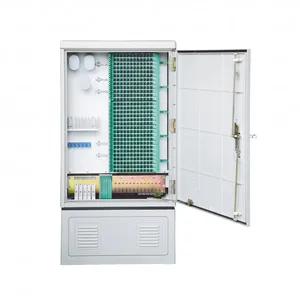
JFDC-288A Fiber Distribution Cabinet
288 ports FDC with wall/pole mounting options
View Product →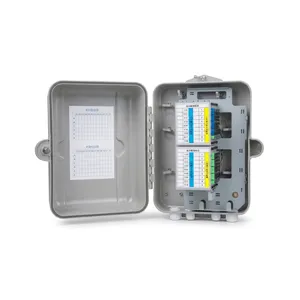
JFDB-64A Fiber Distribution Box
64 ports FDB with SMC material and integrated splitter
View Product →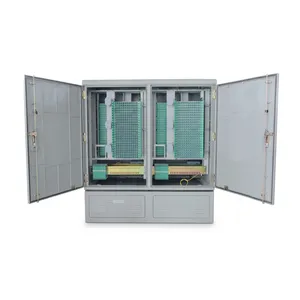
JFDC-1152A Fiber Distribution Cabinet
High-capacity 1152 ports fiber distribution cabinet with SMC material
View Product →References
Key takeaway
SMC is the default choice for outdoor fiber cabinets from 72 to 1152 ports — it balances corrosion immunity, lightweight construction, and 20+ year lifespan at a competitive cost. Steel is required when 19-inch rack mounting or high physical security is needed. ABS/PC+ABS is the right call for high-volume, small-capacity distribution boxes (12–96 ports) where per-unit cost drives purchasing decisions. Match the material to the deployment environment and the cabinet's functional requirements, not just to the purchase price.
Related products
Related Articles
FDC vs FDH vs ODC: What's the Difference?
Understand the three naming conventions for fiber cabinets and how to choose by function.
Read Article →
Fiber Distribution Cabinet Buying Guide
How to spec and select the right FDC for your FTTH project — port count, IP rating, material, and mounting options.
Read Article →
Outdoor Fiber Termination Box Guide
Capacity selection, IP rating, and installation best practices for outdoor fiber termination boxes.
Read Article →