Inspur Digital Enterprise Sacrifices Short-Term Profit for AI \u2014 What It Means for Data Center Fiber Infrastructure
By Jergeo Engineering Team | August 3, 2026 \u00b7 Based on Inspur Digital Enterprise H1 2026 Profit Alert

TL;DR
Inspur Digital Enterprise (0515.HK) expects H1 2026 revenue of RMB 370\u2013380 million (down 11.6\u201314.0% YoY) and net profit of just RMB 60\u201370 million (down 61.1\u201366.7% YoY) \u2014 not because the business is failing, but because the company is deliberately shrinking traditional IT to bet everything on AI. This pivot by one of China's largest IT integrators mirrors a global pattern: traditional IT companies are redirecting capital and engineering capacity toward AI data center infrastructure. For the ODN equipment supply chain, this means sustained, structurally accelerating demand for high-density fiber patch panels, optical distribution frames, and MPO/MTP connectivity designed for 400G/800G AI data center environments.
On July 28, 2026, Inspur Digital Enterprise (HKEX: 0515), one of China's largest enterprise IT software and cloud service providers, issued a profit alert for the first half of 2026. The numbers were stark: revenue expected at RMB 370\u2013380 million, representing a year-over-year decline of 11.6% to 14.0%; net profit attributable to shareholders of RMB 60\u201370 million, a decline of 61.1% to 66.7% compared to H1 2025.
But the decline is not a sign of distress. It is a calculated sacrifice. The company stated that it is "proactively reducing the scale of traditional businesses" and "concentrating resources on core AI tracks." In other words, Inspur is trading short-term revenue and profit for long-term positioning in the AI infrastructure market \u2014 a market that Data Center Dynamics and other industry observers have noted is growing at double-digit rates even as traditional enterprise IT stagnates.
The Financial Picture: Controlled Contraction
The profit alert provides a window into how a traditional IT company manages the transition to AI:
- Revenue: RMB 370\u2013380 million, down 11.6\u201314.0% YoY \u2014 the decline reflects deliberate exit from lower-margin traditional distribution and integration contracts
- Net profit: RMB 60\u201370 million, down 61.1\u201366.7% YoY \u2014 the sharper profit decline indicates significant investment spending on AI product development and talent acquisition
- Strategy: "Proactively reducing traditional business scale" \u2014 management is consciously sacrificing top-line growth to redirect engineering and sales resources toward AI-related software, cloud services, and data center solutions
This pattern is not unique to Inspur. Across the global IT industry, companies that built their businesses on traditional enterprise hardware distribution, systems integration, and legacy software are facing a choice: pivot to AI or face gradual irrelevance. The companies that pivot early accept short-term financial pain \u2014 declining revenue, compressed margins, higher R&D spending \u2014 in exchange for a position in a market that is structurally expanding.
Why Traditional IT Companies Are Willing to Sacrifice Profit for AI
The calculus is straightforward. Traditional enterprise IT spending is growing at low single digits \u2014 or contracting, as Inspur's numbers show. AI infrastructure spending is growing at 30\u201365% annually, as Corning's Q2 2026 results demonstrated with 32% year-over-year growth in optical communications revenue and 65% growth in enterprise networks. A company that continues allocating 80% of its resources to a shrinking market will eventually shrink with it. A company that reallocates 50% of its resources to a market growing at 40%+ will, within three to five years, have a fundamentally different business.
Inspur Digital Enterprise's strategy is specifically focused on AI-related enterprise software, AI-enabled cloud services, and AI data center solutions. As an integrator and software provider, the company's pivot means it will be specifying, procuring, and deploying AI data center infrastructure on behalf of its enterprise and government customers. Every AI data center it builds or integrates requires a full stack of passive fiber infrastructure \u2014 from MPO patch panels in the rack to optical distribution frames in the meet-me room.
AI Data Centers: A Different Fiber Infrastructure Paradigm
The fiber infrastructure requirements of an AI data center differ fundamentally from a traditional enterprise data center. Understanding these differences is essential for ODN equipment suppliers and procurement teams:
High-Density MPO Connectivity
Traditional data centers use LC duplex connectors, with each connector handling 2 fibers. A standard 1U patch panel terminates 24\u201348 fibers. AI data centers use MPO/MTP connectors that terminate 12, 16, or 24 fibers per connector. A 1U AI patch panel like the AI Fiber Patch Panel terminates up to 144 fibers \u2014 a 3\u20136x density improvement. This density is not a luxury; it is a necessity. An NVIDIA DGX SuperPOD can require over 30,000 fiber connections, and using traditional LC panels would consume 25+ racks just for patch panels.
400G and 800G Transceiver Support
AI training clusters run on 400G (QSFP-DD/OSFP) and 800G (OSFP) transceivers that use MPO interfaces for SR4, SR8, DR4, and DR8 optics. The patch panels must accept MPO-12, MPO-16, and MPO-24 connectors and support Type A/B/C polarity configurations. Standard LC-centric patch panels cannot accept these connectors without conversion modules that add insertion loss and failure points. The Jergeo AI Fiber Patch Panel series is designed specifically for these transceiver architectures, with insertion loss \u22640.35dB for MPO connectors.
Spine-Leaf Topology and Cross-Connect Density
AI data centers use spine-leaf (fat-tree) topologies where every leaf switch connects to every spine switch. This creates massive fiber counts at the spine and MDA (Main Distribution Area) layers. Optical Distribution Frames (ODFs) at these layers need to handle thousands of fiber terminations with sliding-tray designs for maintenance access. The AI Fiber Patch Panel (4U) handles 576 fibers per panel, and dozens of these panels may be deployed in a single MDA.
The Role of ODN Passive Equipment in the AI Buildout
Optical Distribution Network (ODN) passive equipment \u2014 patch panels, ODFs, fiber distribution cabinets, splice closures \u2014 is the invisible layer that makes AI data centers function. Every fiber strand that connects a GPU to a switch, a leaf to a spine, or a data center to the internet must be terminated, managed, and protected by passive infrastructure. The relationship is direct and proportional: more AI compute means more fiber, which means more patch panels, ODFs, and distribution cabinets.
What makes the current cycle different from previous data center buildouts is the density requirement. A traditional data center rack uses 12\u201348 fiber ports. An AI training rack uses 96\u2013192 fiber ports. A hyperscale AI data center with 50,000 GPUs may need over 500,000 fiber terminations. This is why high-density MPO patch panels and modular ODF systems are seeing demand growth that outpaces the overall data center market.
For companies like Inspur that are pivoting to AI integration and services, the procurement of ODN equipment becomes a strategic decision. They need suppliers who can deliver high-density MPO solutions at scale, with OEM/ODM customization for specific data center architectures, and with quality certifications that meet hyperscale operator standards.
Implications for Procurement Teams and ODN Suppliers
The Inspur profit alert is a single data point, but it represents a broader industry pattern that has direct implications for fiber infrastructure procurement:
- Volume will accelerate: As more traditional IT integrators pivot to AI, the number of companies specifying and procuring AI data center fiber infrastructure will increase. Demand for high-density MPO patch panels, ODFs, and fiber distribution cabinets will grow proportionally.
- Density requirements will tighten: AI data center operators are already specifying 144+ fibers per rack unit as a minimum. Suppliers still offering only standard LC patch panels will find themselves locked out of AI data center projects.
- Customization is expected: AI data center architectures vary significantly between hyperscalers. OEM/ODM capability \u2014 custom port counts, connector types, polarity schemes, and rack depths \u2014 is becoming a procurement requirement, not an option.
- Lead time matters: AI data center construction timelines are aggressive. GPU clusters are often installed before the building is fully commissioned. ODN equipment suppliers who can deliver in 15\u201320 days for standard configs and 25\u201335 days for custom configs will win orders over slower competitors.
- Quality is non-negotiable: A single fiber disruption can halt a multi-million-dollar AI training job. Insertion loss, return loss, and polarity accuracy must meet specification on every single connector \u2014 not just on average.
Jergeo Fiber Infrastructure for AI Data Centers
As traditional IT companies like Inspur pivot to AI, the demand for purpose-built fiber infrastructure is accelerating. The Jergeo AI Fiber Patch Panel series delivers up to 576 fibers in 4U with MPO/MTP connectivity for 400G/800G transceivers \u2014 available in 1U, 2U, and 4U configurations with OEM/ODM customization, MOQ from 1.
For main cross-connect rooms, Jergeo Optical Distribution Frames provide sliding-tray designs supporting up to 1,440 ports per frame. For campus-level distribution, Jergeo Fiber Distribution Cabinets offer IP65-rated outdoor enclosures with up to 288 ports.
View All ODN ProductsRelated Products
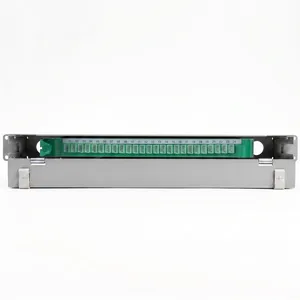
JODF-U1 Standard Fixed Tray Patch Panel
1U high-density MPO patch panel, up to 144 fibers, 400G/800G ready
View Product \u2192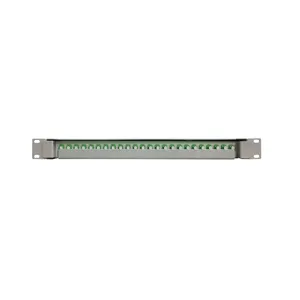
JODF-U3A Optical Patch Panel
24-96 ports sliding type patch panel for data centers
View Product \u2192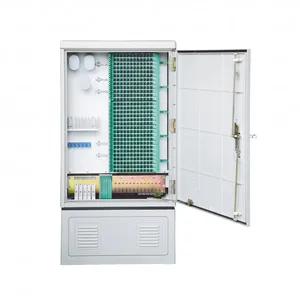
JFDC-288A Fiber Distribution Cabinet
288 ports FDC with wall/pole mounting options
View Product \u2192Related Articles
Corning Expands US Optical Fiber Capacity 10x for NVIDIA AI Factories
Corning Q2 2026: optical communications sales up 32%, 10x capacity expansion with NVIDIA.
Read Article \u2192 Industry AnalysisMark Cuban's AI Datacenter Warning
Power, land, and fiber constraints threatening the AI infrastructure buildout cycle.
Read Article \u2192 Industry NewsAIDC Prefab Module Malaysia 2026
Prefabricated data center modules accelerating AI infrastructure deployment in Southeast Asia.
Read Article \u2192Sources
This article is based on Inspur Digital Enterprise's H1 2026 profit alert filed with the Hong Kong Stock Exchange (HKEXnews.hk, July 28, 2026). Financial figures and strategic statements are sourced directly from the company's official disclosure. Additional context from Sina Finance and Data Center Dynamics. Corning Q2 2026 data referenced from Jergeo's prior coverage.